
Written by ZufishanMS Environmental ScienceLast reviewed
The CBSE formula and its origin
CBSE introduced grading at the secondary level, for classes IX and X, from the 2009-10 academic year, so the class X results of 2010 showed grades and a CGPA. Its Circular No. 24 of 28 May 2010 gave an indicative equivalence: overall indicative percentage of marks = 9.5 × CGPA. The circular does not explain the 9.5; one effect is that a perfect 10.0 CGPA corresponds to 95%, not 100%.
Formula: Percentage = CGPA × 9.5
Worked examples: converting CBSE CGPA to percentage
| CGPA | Calculation | Percentage |
|---|---|---|
| 10.0 | 10.0 × 9.5 | 95.0% |
| 9.6 | 9.6 × 9.5 | 91.2% |
| 9.2 | 9.2 × 9.5 | 87.4% |
| 8.8 | 8.8 × 9.5 | 83.6% |
| 8.4 | 8.4 × 9.5 | 79.8% |
| 8.0 | 8.0 × 9.5 | 76.0% |
| 7.5 | 7.5 × 9.5 | 71.25% |
| 7.0 | 7.0 × 9.5 | 66.5% |
| 6.5 | 6.5 × 9.5 | 61.75% |
| 6.0 | 6.0 × 9.5 | 57.0% |
CBSE 9-point grade scale
| Grade | Grade points | Marks range | Percentage equivalent |
|---|---|---|---|
| A1 | 10 | 91 to 100 | 95.0% |
| A2 | 9 | 81 to 90 | 85.5% |
| B1 | 8 | 71 to 80 | 76.0% |
| B2 | 7 | 61 to 70 | 66.5% |
| C1 | 6 | 51 to 60 | 57.0% |
| C2 | 5 | 41 to 50 | 47.5% |
| D | 4 | 33 to 40 | 38.0% |
| E1 | Pass | 21 to 32 | Not converted |
| E2 | Fail | 0 to 20 | Not converted |
E1 and E2 are pass or fail outcomes not expressed as grade points. CGPA is calculated using only the five main subjects that contribute grade points from A1 to D.
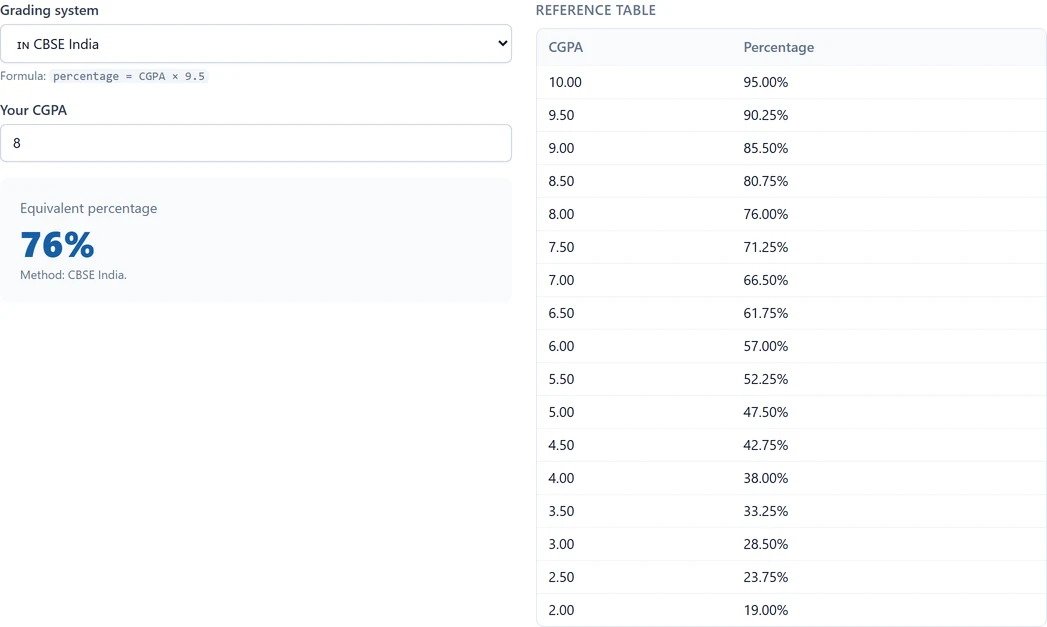
How to convert CBSE CGPA to percentage with this calculator
- Confirm the CBSE India formula is selected in the dropdown.
- Enter your overall CGPA from your grade sheet (usually between 4.0 and 10.0).
- Read the equivalent percentage in the result panel.
- For per-subject percentage, multiply each subject's grade point by 9.5 separately.
Why CBSE students still need this conversion
Students from the grading years have class X grade sheets showing a CGPA rather than marks. CBSE itself does not calculate or declare a percentage; its notice of 30 November 2023 says any calculation is for the admitting institution or employer. College admissions, government job applications, polytechnic and ITI admissions, and scholarship forms all ask for a percentage. The 9.5 formula gives those students a numerically consistent figure for any such form.
CBSE vs ICSE conversion
ICSE (CISCE) issues marks directly for both class 10 and class 12, so no conversion formula is needed for ICSE results. The 9.5 multiplier is specific to CBSE's grading era and should not be applied to ICSE, state board, or university CGPA results.
Common mistakes when converting CBSE CGPA to percentage
Applying the 9.5 formula to a university degree CGPA. The CBSE formula covers class 10 results issued under the CGPA scheme on a 10-point scale. Undergraduate and postgraduate university degrees use different formulas. Applying 9.5 to a 7.5 university CGPA gives 71.25%, but the correct general university formula gives (7.5 minus 0.75) times 10 = 67.5%. The error overstates the result by 3.75 percentage points.
Treating 10.0 CGPA as 100%. Under CBSE, a perfect 10.0 CGPA equals 95%, not 100%. This is by design. A 10.0 CGPA means the student received A1 in all five main subjects, which corresponds to marks in the 91 to 100 range, not necessarily 100 in each.
Converting only selected subjects. The overall CGPA on the grade sheet is calculated from the best five subjects. Enter that overall CGPA figure for the percentage conversion. Do not average individual subject percentages to get the overall result.
Related calculators
- CGPA to Percentage India for university-level formulas including Anna University and VTU
- CGPA to GPA for converting CBSE CGPA to the US 4.0 scale
- Percentage to CGPA for the reverse conversion
- School Percentage Calculator for converting subject marks directly to percentage
- CGPA to Percentage for all systems including Pakistani universities in one tool
Disclaimer: Results use the official CBSE formula of CGPA times 9.5. This formula is published by the Central Board of Secondary Education and applies to class 10 results issued under the CGPA grading system. Class 12 results were issued in marks. It does not apply to university degrees or other boards.
Sources
The formula on this page follows the documents below. Confirm any figure that matters with the issuing body or your registrar.
- CBSE: Circular No. 24/28-05-2010 (grading at secondary level, Classes IX and X): "Overall indicative percentage of marks = 9.5 x CGPA"; read 20 September 2026
- CBSE: Notice "Calculation of percentage of Class X & XII", 30.11.2023: The Board does not calculate or declare a percentage; the admitting institution or employer may; read 20 September 2026
- Central Board of Secondary Education (CBSE): CGPA × 9.5 conversion and 10-point grade bands