
Written by ZufishanMS Environmental ScienceLast reviewed
How merit lists work in Pakistan
Pakistani universities publish ranked merit lists for each program during admission season. Your position on the list depends on your aggregate, which combines Matric, Intermediate, and entry test percentages using a fixed weighting formula. Seats are filled from the top of the list until all seats are allocated. The percentage at which the last seat is awarded is the closing merit for that year.
Standard formulas by program
| Program | Matric | Inter / FSc | Entry test |
|---|---|---|---|
| MBBS / BDS (PM&DC Regulations 2025) | 10% | 40% | 50% |
| UET Lahore engineering (Fall 2026 prospectus) | 17% | 50% (Part-I) | 33% |
| NUST (merit criteria, NET basis) | 10% | 15% (Part-I) | 75% |
| General BS programs (example only) | 25% | 50% | 25% |
The first three rows come from the documents cited below; the general BS row is an example, because each university sets its own weights. Other universities, such as FAST-NUCES, are not listed because we could not check their weights against current university documents. Always check your target university's current prospectus.
Worked example: calculating admission merit
A student applying for MBBS with these scores:
| Component | Score | Weight | Contribution |
|---|---|---|---|
| Matric | 90% | 10% | 9.0 |
| FSc Pre-Medical | 85% | 40% | 34.0 |
| MDCAT | 82% | 50% | 41.0 |
| Total merit | 100% | 84.0% |
Compare an 84% merit with last year's official merit list for the college you want; closing merits differ by college, seat category and year.
Where to find closing merits
Closing merits change every year and differ by college, discipline and seat category. Universities publish them with each merit list; UET Lahore, for example, posts minimum aggregate reports on its admissions downloads page. This page does not show estimated ranges, because we could not check them against official lists.
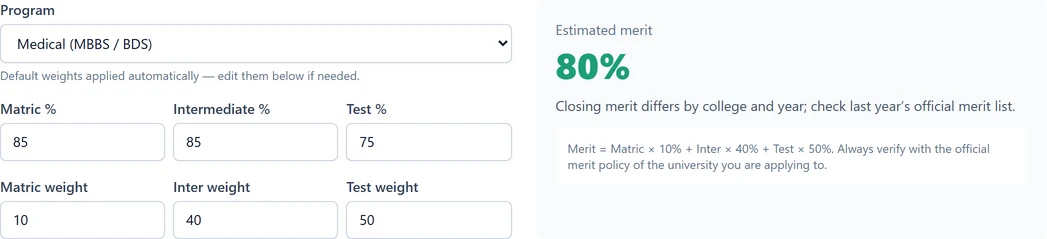
How to calculate admission merit with this calculator
- Select the program preset from the dropdown.
- Check the weights shown match your university's published formula. Edit them if needed.
- Enter your Matric percentage, Intermediate percentage, and entry test percentage.
- Read your estimated merit percentage in the result panel.
- Compare your merit against the closing merits from last year to gauge your chances.
When to use the Merit Calculator Pakistan
Use it after your entry test results are announced to calculate your merit before university merit lists are published. Use it with different score scenarios to plan which programs are realistic and which would require a stronger test performance. For MBBS specifically, use the dedicated MDCAT Aggregate Calculator which is pre-loaded with the PMDC weighting. For engineering admissions, use the ECAT Aggregate Calculator.
Common mistakes when calculating admission merit
Using the wrong formula for your university. NUST weights the entry test at 75%, far higher than the 50% MDCAT weight set by PM&DC or the 33% ECAT weight in UET Lahore's formula. Using the wrong preset will give a significantly wrong merit estimate.
Entering your marks instead of your percentage. All three fields need percentages, not raw marks. If your Matric result shows 950 out of 1100, calculate the percentage first: 950 divided by 1100 times 100 equals 86.4%.
Comparing your merit to closing merits from several years ago. Closing merits shift with the applicant pool size each year. Use the most recent cycle's data for a realistic comparison.
Related calculators
- MDCAT Aggregate Calculator for MBBS and BDS admission merit
- ECAT Aggregate Calculator for engineering admission merit
- COMSATS Merit Calculator and FAST Aggregate Calculator for those universities' own formulas
- HEC Aggregate Calculator for general HEC aggregate scores
- Matric Percentage Calculator for converting Matric marks to percentage
- FSc Grade Calculator for converting FSc marks to percentage
- NTS Score Calculator for universities that weight an NTS NAT score
- NUST Aggregate Calculator for the NET 75% + FSc 15% + Matric 10% weightage
- HEC CGPA to Percentage for postgraduate merit that uses your bachelor CGPA
- CGPA to Percentage for Pakistani universities for university-specific conversion notes
Disclaimer: Merit estimates are based on the standard formulas shown and the percentages you enter. Actual merit lists are compiled by universities using official policies that may include additional criteria such as domicile, gender quotas, and special seats. Always refer to the official prospectus and merit lists of your target university.
Sources
The formula on this page follows the documents below. Confirm any figure that matters with the issuing body or your registrar.
- Higher Education Commission of Pakistan (HEC): Recognised-university list and higher-education policy
- PM&DC: Medical and Dental Undergraduate Education (Admissions, Curriculum and Conduct) Policy and Regulations 2025: Regulations 4(3) and 5(2): MDCAT 50%, FSc/HSSC 40%, Matric/SSC 10% for public and private colleges; read 19 September 2026
- UET Lahore: Undergraduate Prospectus Fall 2026, "Determination of Merit": ECAT programmes: entrance test 33%, first-year (Part-I) intermediate 50%, Matric 17%; minimum aggregate 50%; read 19 September 2026
- National Testing Service (NTS): NAT / GAT score reporting
- NUST: Merit Generation Criteria for UG admission on NET basis: NET 75%, HSSC (Part-1) 15%, SSC 10%; re-checked 19 September 2026 against the current page (the page carries no year)