
Written by ZufishanMS Environmental ScienceLast reviewed
How marks are converted to a percentage
The formula is the same regardless of how many subjects you have or how different the maximums are. Add the marks obtained in every subject, add the maximum marks for every subject, then divide the first total by the second and multiply by 100.
Formula: Percentage = (Total Marks Obtained ÷ Total Maximum Marks) × 100
Step-by-step example: converting marks to percentage
A five-subject result with mixed maximums:
| Subject | Marks obtained | Maximum marks |
|---|---|---|
| English | 78 | 100 |
| Mathematics | 92 | 100 |
| Science | 65 | 75 |
| Social Studies | 55 | 75 |
| Urdu | 83 | 100 |
| Total | 373 | 450 |
Percentage = (373 ÷ 450) × 100 = 82.9%, which is a B− (the 80 to 82 band) on the standard US scale. On the BISE scale used by Pakistan boards it is A1 (printed as A+ by some boards), the top grade from 80%.
Reading your marks to percentage result
The calculator shows a US letter grade alongside the percentage. Here is how the two scales compare:
| Percentage | US letter grade | Pakistan BISE boards |
|---|---|---|
| 90 to 100 | A− to A+ | A1 (A+) |
| 80 to 89 | B− to B+ | A1 (A+) |
| 70 to 79 | C− to C+ | A |
| 60 to 69 | D− to D+ | B |
| 50 to 59 | F | C |
| 40 to 49 | F | D |
| 33 to 39 | F | E |
| Below 33 | F | F (fail) |
Grade divisions vary by board and institution. Use the percentage figure as the universal reference when applying to different systems.
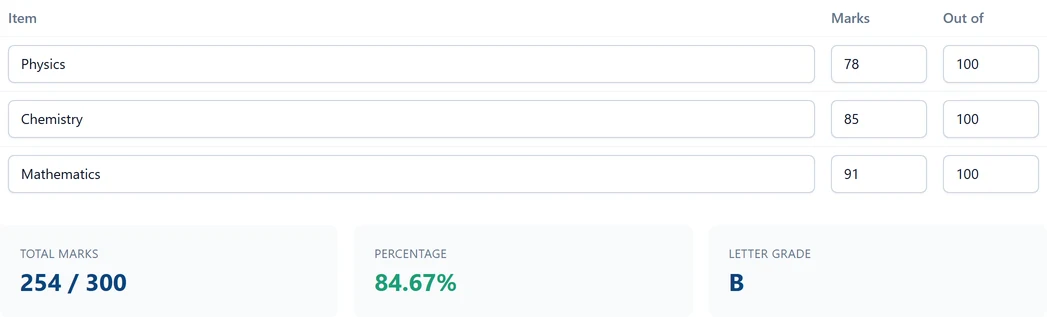
How to convert marks to percentage with this calculator
- Add a row for every subject on your result sheet.
- Enter the marks you received in the Marks column.
- Enter the maximum marks for that subject in the Out of column.
- Read the total marks, percentage, and letter grade in the result tiles below.
Subject names are optional. They help you keep track when entering a long result sheet, but the calculation does not need them.
When to use the Marks to Percentage Calculator
Use it when a university application, scholarship form, or job portal asks for an overall percentage and your result sheet only shows marks per subject. It also works for internal tests and mid-term results that mix subjects with different total marks. For Pakistan board-specific calculations, the Matric Percentage Calculator and FSc Grade Calculator cover the BISE formula. For CBSE class X, use the CBSE CGPA to Percentage converter instead.
Common mistakes when converting marks to percentage
Rounding marks before summing. Enter the raw marks exactly as they appear on your result sheet. Rounding each subject first and then adding introduces small errors that grow with more subjects.
Using the same maximum for every subject. Practical subjects, labs, and oral exams often carry different maximums. Set each row's Out of field to the actual maximum for that subject, not a blanket figure.
Including pass or fail subjects. Most boards exclude pass or fail items from the percentage calculation. Leave those rows out, or the total maximum will be inflated.
Separating theory and practical into two calculators. If your board reports theory and practical on the same result sheet as one subject, enter them as one row using the combined marks and maximum. If they appear as separate line items, enter them as two rows.
Where a marks-to-percentage figure is actually used
- Government job forms in Pakistan and India. FPSC, PPSC, SSC and state PSC applications ask for percentage per qualification, not marks. Enter each level’s total and maximum once and copy the result.
- Scholarship eligibility. Most merit scholarships set a percentage floor (often 60%, 70% or 80%). A student with 886 out of 1100 needs to know that is 80.5%, not guess.
- Comparing results across boards. A 1050/1200 from one board and a 960/1100 from another cannot be compared as marks; as 87.5% and 87.3% they can.
Related calculators
- Exam Percentage Calculator for converting exam paper marks to a percentage
- Matric Percentage Calculator for Pakistan class 10 BISE results
- FSc Grade Calculator for Pakistan Intermediate percentage
- School Percentage Calculator for overall school results
- CGPA to Percentage for converting a CGPA into a percentage
Disclaimer: Results are educational estimates based on the standard percentage formula and the marks you enter. Board-specific rounding rules, grace marks, and subject weightings may produce a different official result. Always confirm your percentage with your institution or board.