
Written by ZufishanMS Environmental ScienceLast reviewed
How the MDCAT aggregate is calculated
MBBS and BDS admission in Pakistan is regulated by the Pakistan Medical and Dental Council (PMDC), which replaced the Pakistan Medical Commission in 2022. PM&DC's Admissions Regulations 2025 set the weighting below for public colleges (Regulation 4(3)) and private colleges (Regulation 5(2)); admitting universities run the merit lists, and colleges administered by the Armed Forces admit through NUMS and its own test. The formula gives the MDCAT the highest weight because it is the standardised measure of aptitude across all candidates, regardless of which board or province their Matric and FSc results come from.
Aggregate = (Matric % × 0.10) + (FSc % × 0.40) + (MDCAT % × 0.50)
Worked example: calculating MDCAT aggregate
| Component | Score | Weight | Contribution |
|---|---|---|---|
| Matric | 91% | 10% | 9.1 |
| FSc Pre-Medical | 87% | 40% | 34.8 |
| MDCAT (164 out of 200) | 82% | 50% | 41.0 |
| Aggregate | 100% | 84.9% |
An 84.9% aggregate is competitive for many provincial government colleges. Improving the MDCAT score by 10 marks (from 164 to 174 out of 200) would add 2.5 percentage points to the aggregate, raising it to 87.4%. This illustrates why MDCAT preparation has the highest return on investment of the three components.
Where to find closing merits
Closing merits depend on the college, the seat category and the year, and the admitting university publishes them with each merit list. This page does not show estimated ranges, because we could not check them against official lists. Compare your aggregate with last year's official merit list for the college you want.
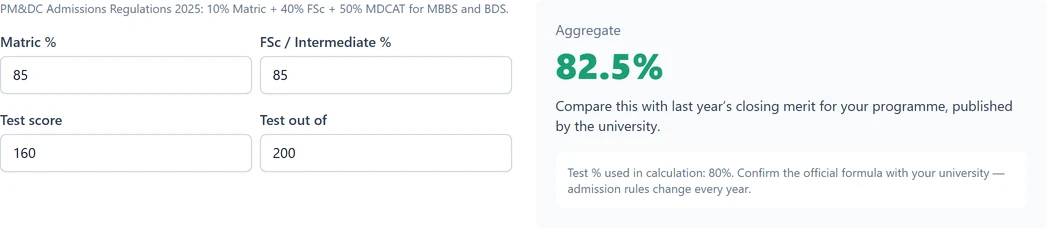
How to calculate MDCAT aggregate with this calculator
- Enter your Matric percentage.
- Enter your FSc Pre-Medical percentage.
- Enter your MDCAT score and the total marks it is out of (usually 200).
- Read your aggregate in the result panel.
- Compare it with last year's official merit list for your target college.
How to improve your aggregate
Since the MDCAT carries 50% of the total weight, it has the most impact on your aggregate. Improving your MDCAT score by 10 marks out of 200 adds 2.5 percentage points. Improving your FSc percentage by 1 point adds only 0.4 percentage points. If you are retaking the MDCAT, focus your preparation there rather than on improving an already-strong FSc result.
When to use the MDCAT Aggregate Calculator
Use it as soon as your MDCAT result is announced to calculate your aggregate before official merit lists are published. Use it beforehand with target MDCAT scores to determine what score you need to reach a particular aggregate. For general university merit across other programs, use the Merit Calculator. For engineering admissions specifically, use the ECAT Aggregate Calculator.
Common mistakes when calculating MDCAT aggregate
Entering raw MDCAT marks as a percentage. If your MDCAT score is 160 out of 200, the percentage is 80%, not 160. Enter 160 in the score field and 200 in the total marks field, and the calculator converts it automatically.
Using an older formula. Admission weightings and the way the MDCAT score is scaled are set by the admitting body for each cycle and have changed in past years. The standard formula here applies the MDCAT percentage directly; if a previous year's resource applies a separate scaling to the MDCAT score, use the current prospectus instead.
Assuming domicile quota seats use the same merit cutoff. Open merit seats and domicile or district quota seats have different closing merits at most colleges. Your aggregate is the same, but the merit list you appear on depends on your domicile certificate.
Related calculators
- NUMS Aggregate Calculator for NUMS and Armed Forces medical and dental colleges
- ECAT Aggregate Calculator for engineering admission aggregate
- Merit Calculator Pakistan for general university admission merit
- HEC Aggregate Calculator for HEC aggregate scores
- Matric Percentage Calculator to convert Matric marks to percentage
- FSc Grade Calculator to convert FSc marks to percentage
Disclaimer: this aggregate uses the weighting in PM&DC's Admissions Regulations 2025, read on 19 September 2026. It is an estimate, not an official PM&DC or university figure. Rules can change between sessions, so check the current PM&DC notices and your admitting university's merit lists before relying on any figure here.
Sources
The formula on this page follows the documents below. Confirm any figure that matters with the issuing body or your registrar.
- PM&DC: Medical and Dental Undergraduate Education (Admissions, Curriculum and Conduct) Policy and Regulations 2025: Regulations 4(3) and 5(2): MDCAT 50%, FSc/HSSC 40%, Matric/SSC 10% for public and private colleges; read 19 September 2026
- PM&DC: Notification No. PF.1-C/2026/Council/Notification/1108, 8 April 2026: MDCAT passing percentage for 2025-26: MBBS 52%, BDS 47%, with a one-time reduction of up to 3% for vacant seats; read 19 September 2026