
GPA vs CGPA: What's the Difference?
The difference between GPA, CGPA and SGPA: one term against your whole record, why 8.5 is not 3.5, and which number to quote on an application.
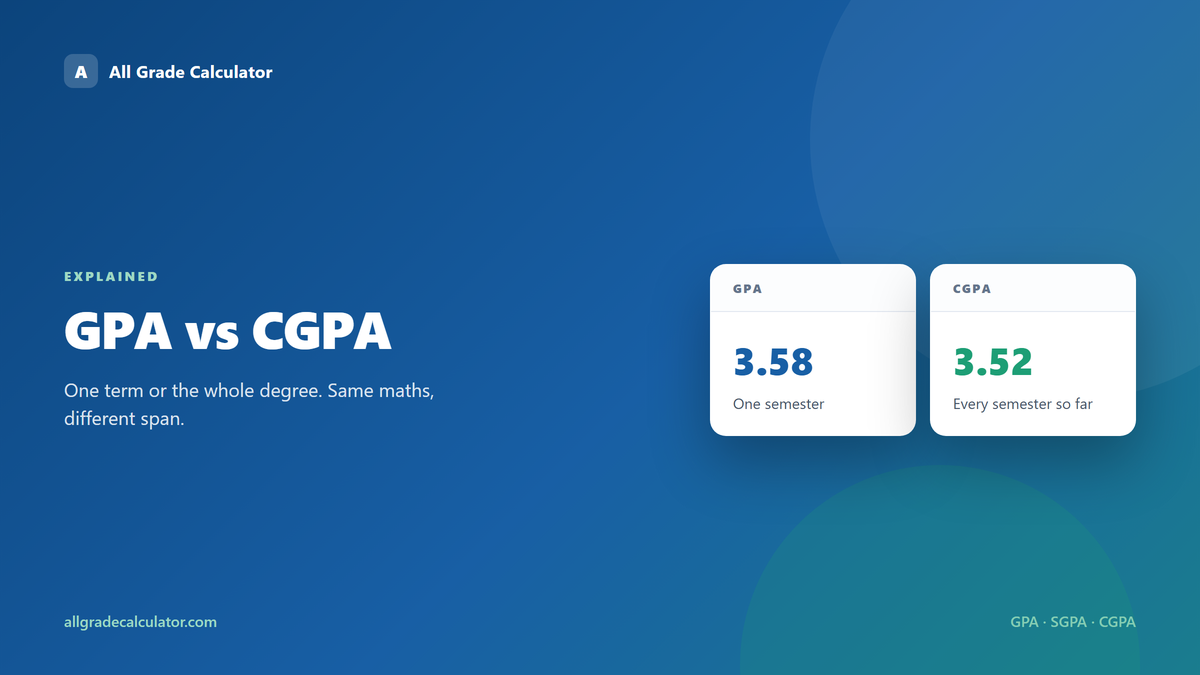
The difference is the span of time. GPA covers one term, CGPA covers every term you have completed, and SGPA is the Indian and Pakistani name for a single semester's GPA. The arithmetic is identical in all three: each grade point is weighted by the course's credits.
Quick answers
- GPA vs CGPA: one term against your whole record so far.
- SGPA vs CGPA: SGPA is one semester; CGPA combines every semester, weighted by credits.
- Same maths: all three are credit-weighted averages of grade points.
- Which to quote: whatever the form asks for, with its scale written beside it.
Every student applying abroad runs into the same alphabet soup: GPA, CGPA, SGPA, percentage, letter grade. This guide untangles all of them and tells you which number to use where.
The short answer
- GPA (Grade Point Average): usually a US-style 4.0 scale single-term number.
- CGPA (Cumulative Grade Point Average): the average across all semesters. Often called "cumulative GPA" in the US.
- SGPA (Semester GPA): the Indian and Pakistani term for a single-semester GPA.
In the US, "GPA" usually implies cumulative GPA in conversation. In India and Pakistan, GPA usually means single-semester and CGPA means cumulative, though the conventions vary.
Why the same word means different things
The US uses a 0.0–4.0 scale almost universally. Indian universities typically use a 10-point scale; some use 7-point (Mumbai University) or 9-point (CBSE). In Pakistan, HEC recommends a 4.0 scale (some legacy institutions still use 5.0). When someone says "my CGPA is 8.5," the maximum could be 10 (India), 4.0 (Pakistan) or 4.0 (US), and the percentage equivalent is wildly different in each case.
How to compare across scales
Convert everything to a percentage first, then make comparisons. The CGPA to percentage tool on allgradecalculator.com handles every common formula:
- CBSE India: % = CGPA × 9.5
- General Indian universities: % = (CGPA − 0.75) × 10
- Anna University (University Departments, R-2015 to R-2019): % = CGPA × 10
- VTU, 2021 and 2022 schemes: % = CGPA × 10
- VTU, 2015/2017/2018 schemes: % = (CGPA − 0.75) × 10
- Mumbai University: no formula since 1 January 2026; your college calculates the percentage from actual marks (Circular Exam/Result/803 of 2026). The former formula was 7.1 × CGPA + 11
- Pakistan, HEC-recommended table (4.0): each CGPA band maps to a percentage band and you take the lowest value, so 3.00 = 71% (HEC Uniform Semester System policy guidelines, section 13.1)
- Pakistan, linear (4.0 / 5.0): % = (CGPA / 4.0) × 100 or (CGPA / 5.0) × 100. Common, but not an HEC formula
Example: when 8.5 is not equal to 8.5
| Source | CGPA 8.5 → percentage |
|---|---|
| CBSE India (10-point) | 80.75 % |
| General Indian universities (10) | 77.50 % |
| Anna University Departments (10) | 85.00 % |
| Mumbai University (7-point) | not valid (max 7) |
| Pakistan (4.0 scale) | not valid (max 4) |
Same number, very different meanings.
What does a US university expect?
US universities convert everything to a 4.0 GPA for evaluation. Some do this internally with a credential evaluator (WES, ECE, IERF). Others ask you for the conversion. The CGPA to GPA converter on allgradecalculator.com is the fastest way to get a defensible 4.0 GPA from any input scale.
What does an Indian or Pakistani employer expect?
Most Indian and Pakistani employers use percentage as the cut-off. A 60% requirement is common for entry-level jobs; 70% or 75% for premium roles. Always provide both your CGPA and the converted percentage on your CV.
SGPA, CGPA, and credit weighting
Both SGPA and CGPA are credit-weighted averages, so a 4-credit course counts twice as much per grade point as a 2-credit course. Use the SGPA to CGPA calculator to compute your cumulative number from semester SGPAs.
A practical playbook
- Find your CGPA on your most recent transcript.
- Identify the scale (10-point, 4.0 and so on), usually printed in the header.
- Convert to a percentage using the right formula.
- If applying to the US, convert further to a 4.0 GPA.
- Cite all three numbers on your CV: CGPA (with scale), percentage, GPA-equivalent.
Frequently asked questions
What is the difference between GPA and CGPA?
GPA is the average for one term. CGPA is the average across every term you have completed, weighted by the credits behind each one. A strong semester raises the GPA sharply and the CGPA only a little, because the CGPA carries all your earlier credits with it.
What is the difference between SGPA and CGPA?
SGPA is a single semester's grade point average, the name used at most Indian and Pakistani universities. CGPA combines every semester so far. Converting semester by semester and then averaging the results is not the same thing, because semesters carry different credit loads; combine the semesters first.
Is CGPA better than GPA?
Neither is better. They answer different questions. An admissions office asking about your whole degree wants the CGPA; a scholarship reviewing your latest term wants that term's GPA. Give whichever the form asks for, and write the scale next to it.
Is a 8.5 CGPA the same as a 3.5 GPA?
No. They sit on different scales, a 10-point one and a 4.0 one, and no universal conversion links them. Each university publishes its own percentage rule, and US admissions offices usually recalculate from the transcript themselves. Quote your original CGPA with its scale rather than a converted figure alone.
How do I calculate CGPA from SGPA?
Multiply each semester's SGPA by that semester's credits, add the products, and divide by total credits. The SGPA to CGPA calculator does it for any number of semesters.