
How to Calculate CGPA: Complete Step-by-Step Guide
What CGPA means, where to check it on your result or student portal, and how to calculate it on the 4.0, 5.0 and 10-point scales, with worked examples for India, Pakistan and the US.
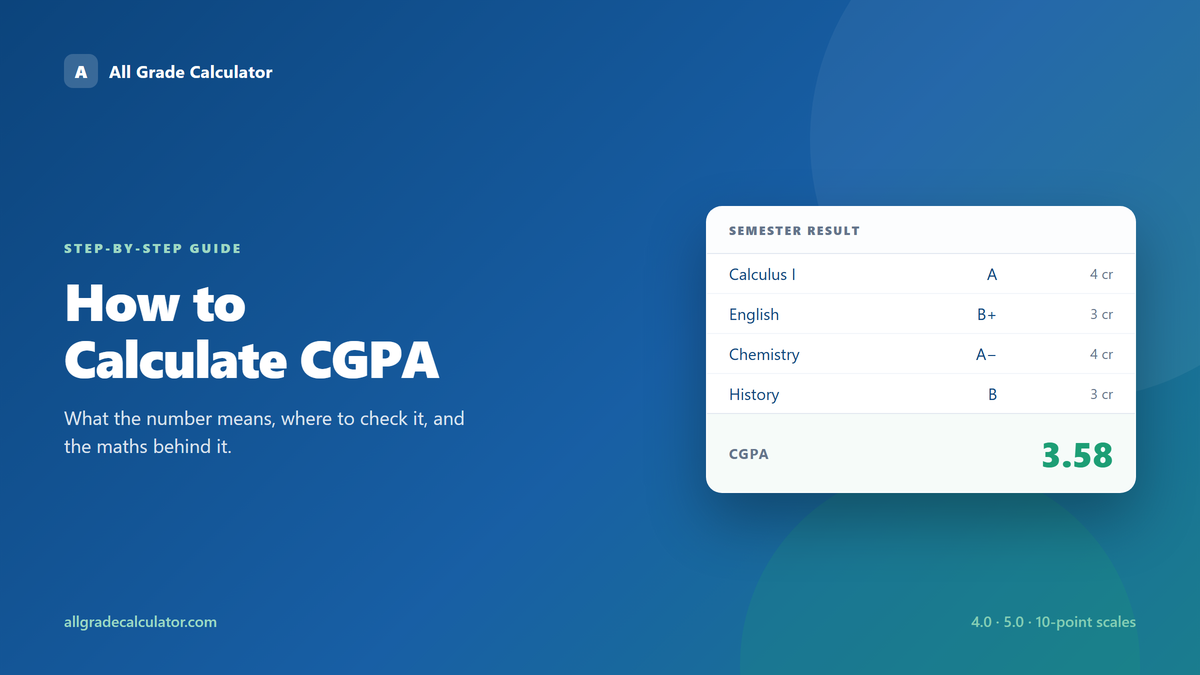
Calculate your CGPA now
CGPA stands for Cumulative Grade Point Average: the credit-weighted average of every grade you have earned across your whole degree, expressed as a single number. Universities, employers, scholarship boards and visa officers all read it. The method varies between countries and even between universities in the same country, which is why the same 8.5 can mean 77.5% at one Indian university and 85% at another.
Quick answers
- Meaning: CGPA is your whole degree so far as one credit-weighted number. SGPA is one semester.
- Where to find it: printed on your semester result and your official transcript. Most universities also show it on the student portal.
- How it is worked out: multiply each course's grade points by its credit hours, add those up, divide by total credit hours.
- Scale: 10-point in most of India, 4.0 in the US and in Pakistan under the HEC table.
This guide covers all three: what the number means, where to check it, and how to calculate it yourself with worked examples.
What does CGPA mean?
CGPA is the credit-weighted average of every grade you have earned across every semester so far. The word cumulative is what separates it from SGPA (Semester GPA), which only covers one term. Grade point means each letter grade maps to a number: A = 4.0 on a US scale, A = 10 on most Indian scales, A = 4.0 on the HEC scale in Pakistan.
Three things CGPA is not:
- Not a percentage. It becomes one only through your university's own conversion rule, and those rules differ. See the table further down.
- Not an average of your semester averages, unless every semester carried identical credits. Credits are the weights.
- Not comparable across universities on its own. A 3.5 on a 4.0 scale and an 8.5 on a 10-point scale are different measurements, not the same achievement in two units.
How to check your CGPA
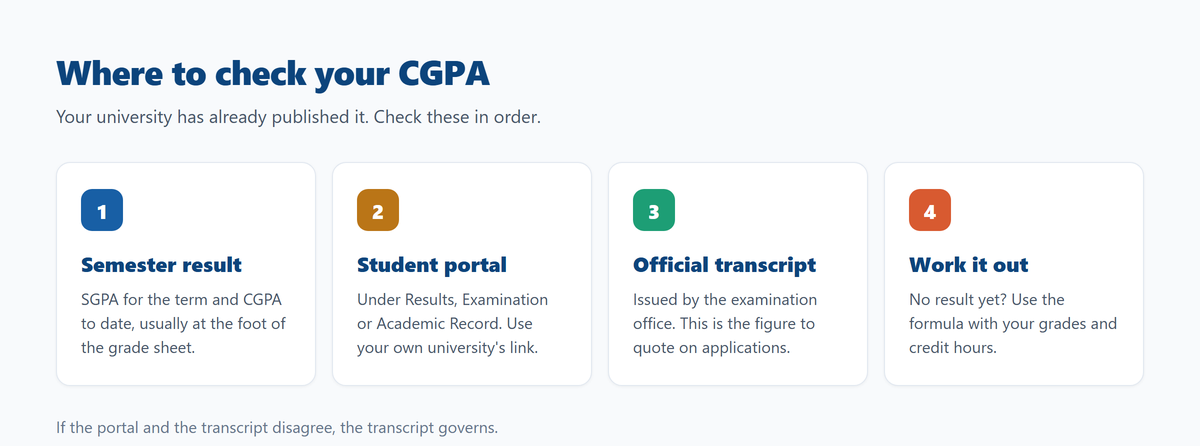
You rarely need to calculate your CGPA yourself, because your university already publishes it. Check these in order:
- Your semester result or grade sheet. Most universities print SGPA for the term and CGPA to date, usually at the bottom of the sheet.
- The student portal or LMS. Nearly every university has one, under a heading such as Results, Examination or Academic Record. You sign in with your enrolment or registration number. The exact name and address differ by university, so use the link on your own university's website rather than a third-party page.
- Your official transcript. Issued by the examination office or controller of examinations. This is the authoritative figure, and it is the one to quote on applications.
- Work it out yourself from your grades and credits, using the formula below, when a result is not out yet or you want to check the arithmetic.
Two cautions. Portal figures can lag behind a revaluation or a cleared backlog, so the transcript governs if the two disagree. And a CGPA printed to two decimals has already been rounded, so your own calculation may differ in the second decimal without either being wrong.
The universal formula
CGPA = Σ (grade_points_i × credits_i) / Σ (credits_i)
In plain English: multiply each course's grade point value by its credit hours, sum across every course, and divide by the total credits. The free GPA calculator on allgradecalculator.com does this for any number of courses, and the cumulative GPA calculator combines several semesters at once.
Worked example on the US 4.0 scale
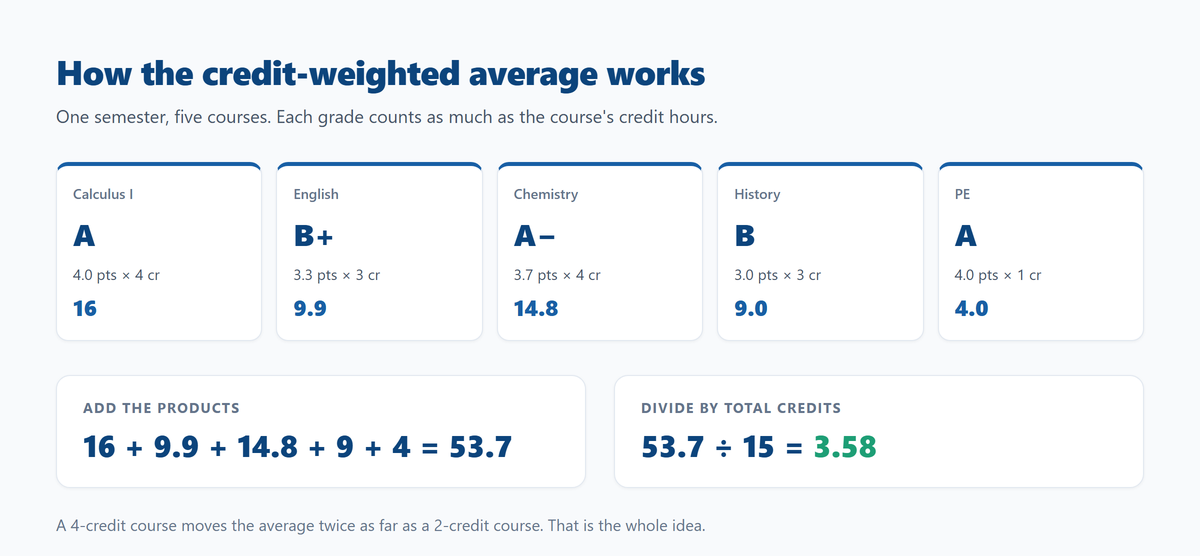
Consider a student with five courses in one semester:
| Course | Letter | Grade pts | Credits | Points × credits |
|---|---|---|---|---|
| Calculus I | A | 4.0 | 4 | 16 |
| English | B+ | 3.3 | 3 | 9.9 |
| Chemistry | A− | 3.7 | 4 | 14.8 |
| History | B | 3.0 | 3 | 9.0 |
| PE | A | 4.0 | 1 | 4.0 |
Total credits = 15. Total points = 53.7. GPA = 53.7 ÷ 15 = 3.58.
If this student carried a 3.6 the previous semester (15 credits) and a 3.4 the semester before that (16 credits), the cumulative CGPA is:
CGPA = (3.58 × 15 + 3.6 × 15 + 3.4 × 16) / (15 + 15 + 16)
     = (53.7 + 54.0 + 54.4) / 46
     = 162.1 / 46
     ≈ 3.52
Worked example on the Pakistani 4.0 scale
Calculating a Pakistani CGPA works exactly like the US 4.0 GPA: credit hours times grade points, divided by total credit hours. HEC's recommended grading table sets different letter boundaries, though. An A starts at 85% and an A− at 80%, rather than 93% for an A in the US. To turn the CGPA into a percentage at the end, use the HEC CGPA to percentage tool, which applies HEC's recommended table (3.00 = 71%) by default.
Individual universities publish their own grade points within that scale. COMSATS, NUST, FAST and UET each have a page here built from their own regulations.
Worked example on the Indian 10-point scale
India's universities use a 10-point CGPA. Many of them, and VTU's 2015, 2017 and 2018 schemes, use:
percentage = (CGPA − 0.75) × 10
Anna University uses CGPA × 10, with no constant, for affiliated colleges under R2021 and for its University Departments (R-2015 to R-2019). Students on older regulations should check their mark sheet. CBSE class X uses CGPA × 9.5. Mumbai University repealed its 7.1 × CGPA + 11 formula on 1 January 2026, so colleges now calculate the percentage from actual marks. Convert your 10-point CGPA to a percentage with the CGPA to percentage (India) tool.
CGPA scale and conversion by university
The same CGPA means a different percentage depending on who issued it. Use this table to pick the right conversion before you compare results across institutions.
| System | Scale | Percentage formula | Tool |
|---|---|---|---|
| US colleges | 4.0 | No official percentage; letter bands per school | GPA calculator |
| Pakistan, HEC-recommended table | 4.0 | Lowest % of the CGPA's band (3.00 = 71%) | HEC CGPA to % |
| Pakistan, linear (common, not HEC) | 4.0 / 5.0 | CGPA × 25 / CGPA × 20 | Pakistani universities |
| Pakistan, NUST / FAST / UET | 4.0 | None published by the university | NUST · FAST · UET |
| CBSE class X | 10 | CGPA × 9.5 | CBSE CGPA to % |
| General formula (many Indian universities) | 10 | (CGPA − 0.75) × 10 | CGPA to % India |
| Anna University Departments | 10 | CGPA × 10 | Anna University CGPA |
| SRM Institute of Science and Technology | 10 | CGPA × 10 | SRM CGPA calculator |
| VIT | 10 | CGPA × 10 | VIT CGPA calculator |
| VTU, 2021 and 2022 schemes | 10 | CGPA × 10 | VTU SGPA |
| VTU, 2015/2017/2018 schemes | 10 | (CGPA − 0.75) × 10 | VTU SGPA |
| Mumbai University | 7 | From actual marks, by the college (former 7.1 × CGPA + 11 repealed 1 Jan 2026) | CGPA to % India |
Common mistakes to avoid
- Treating credit hours as equal. A 4-credit course is twice as important as a 2-credit course. Always weight by credits.
- Mixing scales. Don't average a 10-point CGPA with a 4.0 GPA. Convert to one scale first.
- Forgetting failed courses. Most universities include failed courses (with grade points = 0) in the CGPA. The credits still count.
- Ignoring the academic regulations. Each university has small adjustments such as course retake replacement rules and plus/minus grades. Read your handbook.
How to raise your CGPA quickly
Because CGPA is credit-weighted, the fastest way to raise it is to take more credit hours of courses where you can confidently earn high grades. Re-taking a low-grade course (when policy allows replacement) is the second fastest. Trying to improve a course you've already mostly mastered usually only shifts the CGPA by 0.02, so focus on the big swings.
Frequently asked questions
What is the full form of CGPA?
Cumulative Grade Point Average. Cumulative means it covers every semester completed so far, not just the current one.
How do I check my CGPA?
Look at your semester grade sheet first, then your university's student portal, then your official transcript. The transcript is the authoritative figure. If none of those is available yet, calculate it from your grades and credit hours with the formula above.
Is CGPA out of 10 or out of 4?
Both exist. Most Indian universities use a 10-point scale. The US, and Pakistani universities following the HEC table, use 4.0. A few use 5.0. The scale is printed on your transcript, and it decides which conversion formula applies.
Is CGPA the same as percentage?
No. A CGPA becomes a percentage only through the rule your university publishes, and those rules differ: CGPA × 10 at Anna University Departments, SRM and VIT, (CGPA − 0.75) × 10 under the general Indian formula, CGPA × 9.5 for CBSE class X. Use your own university's rule, and prefer any percentage printed on your transcript over a converted one.
Do failed courses count in CGPA?
At most universities, yes. The failed course contributes zero grade points while its credits stay in the denominator, which is why one F moves a CGPA sharply. Some regulations replace the grade once you clear the backlog, so check your own academic regulations.
What is a good CGPA?
That depends on the scale, the programme and what you need it for, so we do not publish a single number. Compare yours against the requirement printed by the specific scholarship, university or employer you are applying to.