
How to Improve Your GPA: 10 Practical Strategies
Ten practical ways to raise your GPA, starting with the credit-weight lever that moves the average fastest: retakes, course load, and what to check before each midterm.
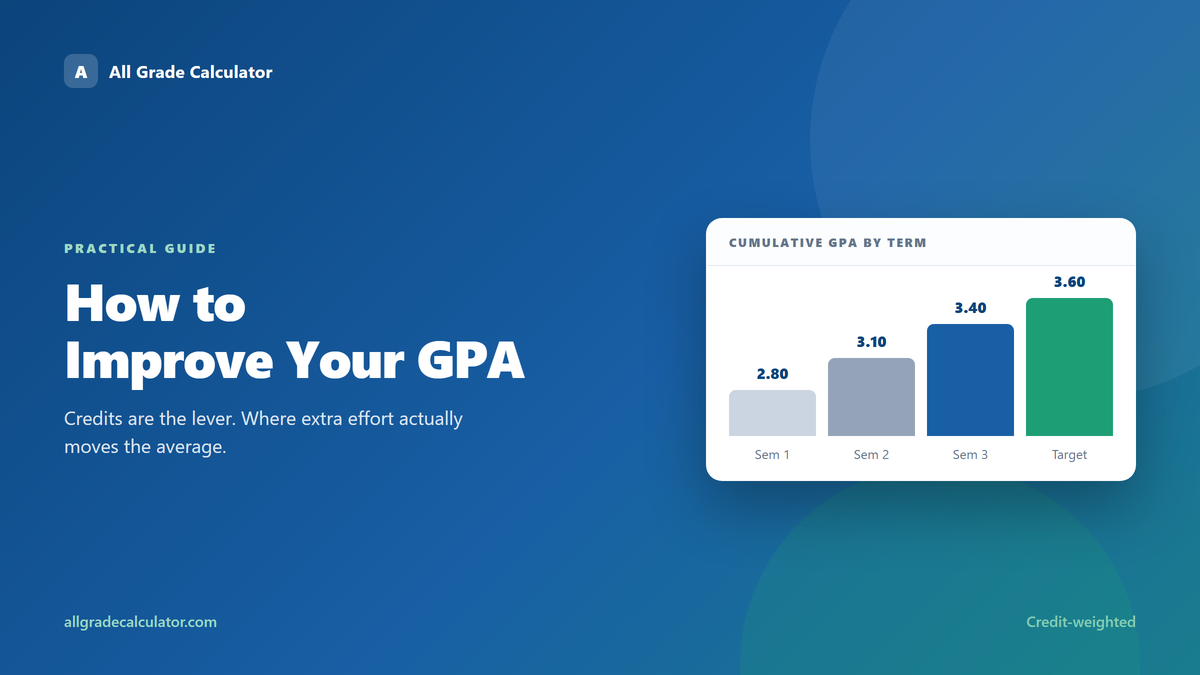
The fastest way to raise a GPA is to work on the courses carrying the most credits, because the average is credit-weighted: a grade in a 4-credit course moves it twice as far as the same grade in a 2-credit one. Everything else on this list is downstream of that.
Quick answers
- Biggest lever: credits. Target the high-credit courses with the lowest grades.
- Second: retakes, where your institution's policy replaces the old grade.
- Realistic pace: 0.1 to 0.3 in a semester. Half a point in one term is rare.
- Check first: your own transcript, before changing anything.
Raising a GPA isn't about working harder for longer. It's about working on the right things in the right order. Here are ten strategies, ranked from most impactful first to nice-to-have last.
1. Audit your transcript before you do anything else
Open the cumulative GPA calculator and enter every course you've taken. Sort mentally by grade. The courses with the lowest grades and the highest credit hours are pulling your GPA down the most. Fix those first.
2. Use the credit-weight lever
Because GPA is credit-weighted, a 4-credit course counts twice as much as a 2-credit course. Adding two more semesters of high-grade, high-credit courses moves your CGPA more than retaking one mediocre course. Plan your remaining semesters with this in mind.
3. Re-take strategically
Most US universities and many international ones replace the original grade when you re-take a course. The boost is significant: a D replaced by an A at 4 credits raises your GPA more than three new A grades at 3 credits each. Do not retake at random. Check your academic regulations for the replacement policy.
4. Use the calculator before each midterm
Mid-semester is the highest-leverage moment. Pull out the grade calculator and enter every assignment, weight, and current score. The result tells you what you need on the rest of the term. Knowing the exact target turns vague anxiety into a concrete plan.
5. Spaced repetition beats cramming
Two hours per day for ten days produces dramatically better recall than twenty hours the night before. Use a flashcard tool (Anki, Quizlet, RemNote) for terminology-heavy subjects. Use practice problems for quantitative subjects.
6. Lecture-active note-taking
Don't transcribe; engage. The Cornell method (questions / notes / summary) and concept mapping both outperform linear notes in retention studies. Re-write your notes within 24 hours of class. That single habit doubles long-term recall.
7. Sleep and exercise are GPA inputs
Sleep and exercise are not separate from study time; they decide how much of it lands. A tired hour of revision is worth less than a rested one, which is why cutting sleep to add study hours tends to trade quality for quantity. We are not citing a study here, so treat this as what it is: the ordinary experience of tired students, not a measured effect size.
8. Visit office hours
Professors grade ambiguous answers more generously when they recognise the student. Visit office hours twice in the first month, even if you have no urgent question. Bring one well-prepared question. The relationship pays compounding returns.
9. Drop the wrong course early
If a course is clearly unsalvageable by week 4, take a W before the withdrawal deadline. A W on a transcript is far less damaging to GPA than a D or F. Confirm your university's withdrawal-vs-fail timeline.
10. Plan course load around energy
Take your hardest-grading courses in semesters where your overall load is lighter. Don't pair organic chemistry with a senior thesis. Plan electives around your stronger areas, which pull the average up.
Bonus: GPA bookmarks for the rest of the semester
- GPA calculator: current semester GPA.
- Cumulative GPA calculator: overall GPA.
- Final exam calculator: what you need on the final.
- Passing grade calculator: minimum to pass.
- Attendance calculator: bunkable classes left.
Frequently asked questions
How can I improve my GPA fast?
Put your effort where the credits are. The average is credit-weighted, so a grade in a 4-credit course moves it twice as far as the same grade in a 2-credit one. Start by listing every course you have taken and finding the ones with low grades and high credits.
How much can a GPA realistically rise in one semester?
Between 0.1 and 0.3 for most students. A half-point jump in a single term is rare, because every earlier credit stays in the denominator. The more semesters behind you, the slower the number moves.
Does retaking a course raise my GPA?
Only if your institution's policy replaces the original grade rather than averaging the two attempts. Read that rule before you register, because the two policies give very different results.
Is it better to take fewer courses to protect my GPA?
It depends on what you would do with the freed time. A lighter load only helps if the remaining courses get the attention, and it also slows your credit accumulation. Dropping early, before the deadline that puts a mark on the transcript, is usually the cleaner option when a course is going badly.
Does a high GPA matter more than experience?
That depends entirely on who is reading it, so we do not publish a rule. Check what the specific programme, scholarship or employer states in its own requirements.
A realistic timeline
A 0.5 GPA increase in a single semester is rare; 0.1–0.3 is realistic for most students who follow these strategies. Over four semesters of steady improvement, you can move a 2.7 GPA to a 3.4, enough to clear graduate school cut-offs and most scholarship requirements.
The fundamentals don't change with the year. Bookmark allgradecalculator.com, run the numbers every month, and the trajectory takes care of itself.